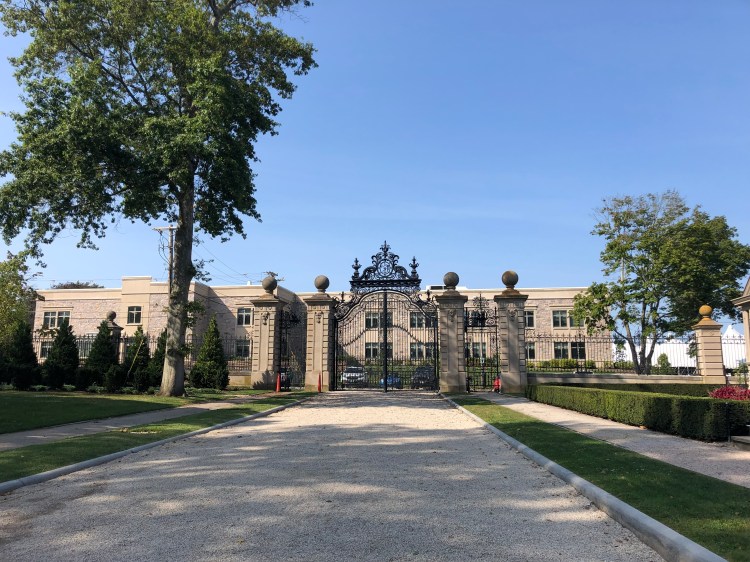
I have been fascinated by the Gilded Age since reading John Jake’s “The Gods of Newport”. I was excited to take the Breakers Mansion tour!
Hopefully you will enjoy my narrative of the Breakers’ history and architecture mixed in with pictures I took during the tour.
History
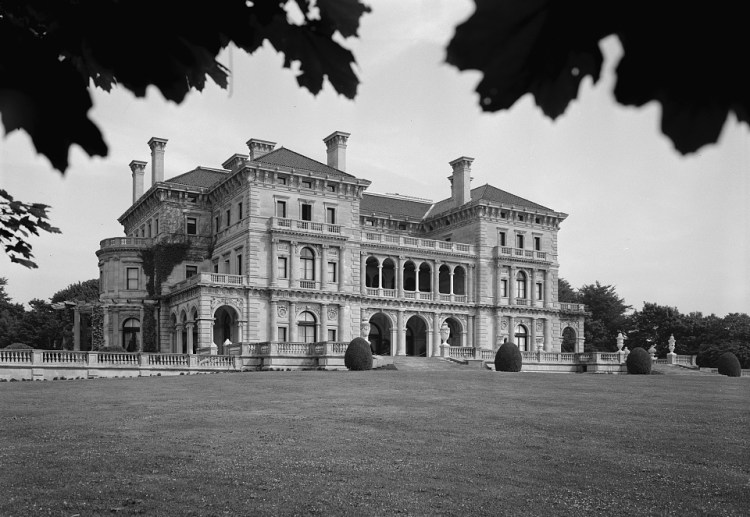
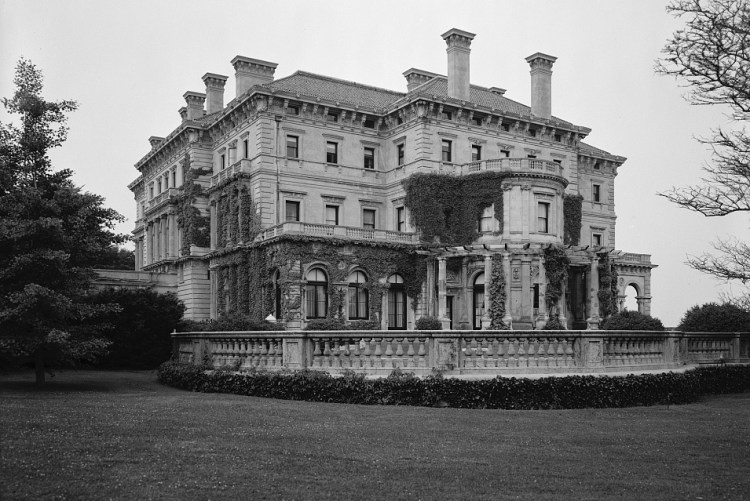
The Breakers on the cliffs of Newport was the epitome of the Gilded Age in turn-of-the-century America. The Vanderbilt family’s “summer cottage” is a symbol of their social and financial supremacy. The mansion was designed by Richard Morris Hunt and built from 1893 to 1895
The mansion was of Italian Renaissance style, modeled after 16th century villas of Genoa. Key features are the central loggia’s and the grand hall. Much of the decorative ornament were inspired from Classical Greek and Roman architecture.

Cornelius Vanderbilt II
Cornelius Vanderbilt II (November 11, 1843 – September 12, 1899) was an American socialite, businessman, and a member of the prominent United States Vanderbilt Family. He was the favorite grandson of Commodore Cornelius Vanderbilt, who bequeathed him $5 million, and the eldest son of William Henry “Billy” Vanderbilt (who bequeathed him about $70 million) and Maria Louisa Kissam.
In his turn he succeeded them as the chairman and the president of the New York Central and related railroad lines in 1885. He built the Breakers, a Gilded Age Mansion, in Newport, RI as a summer residence between 1893

Original Breakers Cottage
The home, which was acquired by Cornelius Vanderbilt II in 1885, was destroyed by fire in 1892 and replaced by the current Breakers. While only extant for 14 years, it “was widely known in the nineteenth century and continues to attract the attention of architectural historians today“.
The Facts
- 5 Levels: 3 floors of main rooms, a basement and an attic
- 70 total rooms with 33 devoted to staff
- 62,482 sq ft of living space
- No wood was used in construction
- The boiler is located away from the house in an underground space
Exterior Architecture

Loggia
The Loggia was two stories high and faced the Atlantic Ocean. The Spandrels were decorated with the four seasons and the Doric 1st Floor cornice was decorated with the Vanderbilt “V” clustered in oak leaves and images of Apollo and Mercury
photo by Jack Boucher, 1971 loc.gov
Arched Doorways
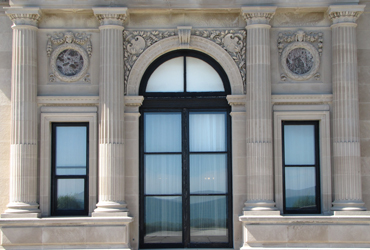
The triumphal arch design of the doorway and its flanking windows is defined by four columns. Above the winders are circular decorative plaques carved with classical figures and laurel.
newportmansions.org
Arcaded Porches
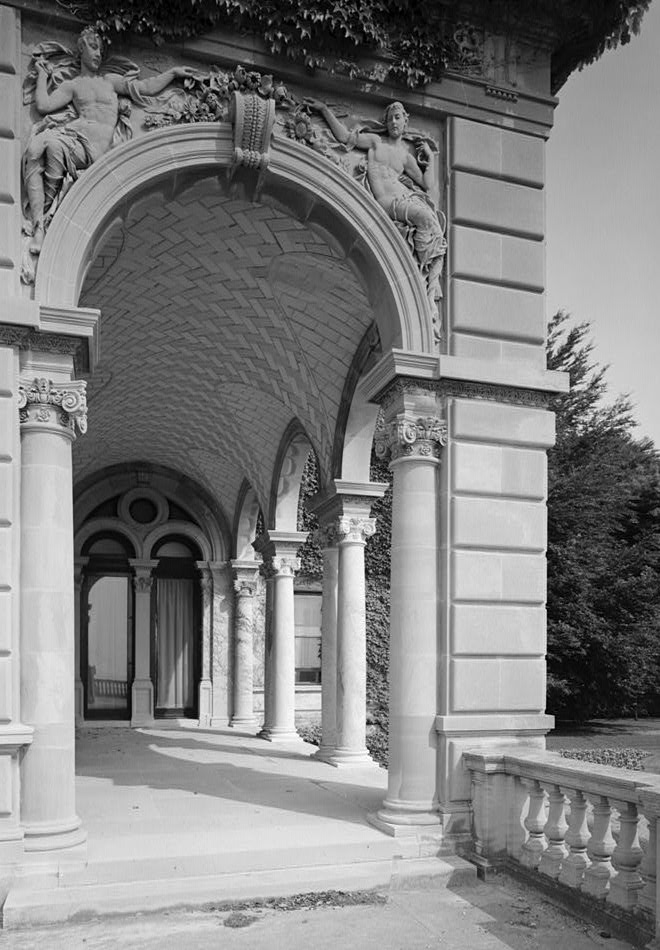
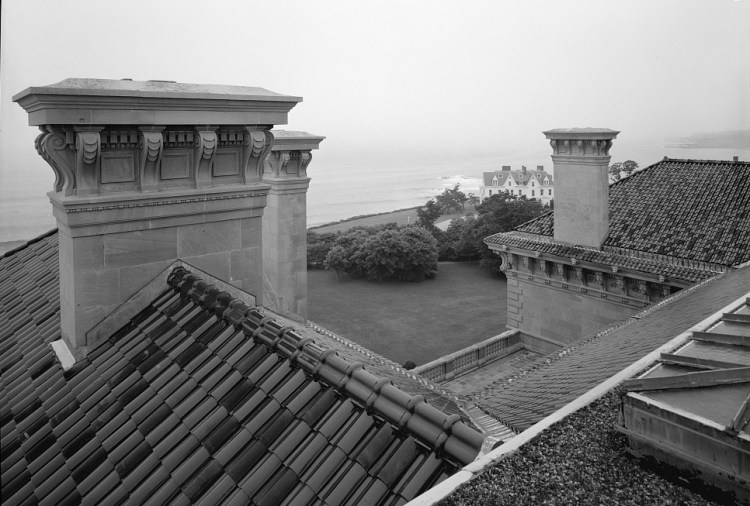
The classical arcaded porches had vaults of tile laid according to the method introduced by Raphael Guastavino, Italian architect and engineer

Photo by Jack Boucher, 1971 loc.gov

Stringcourse
The stringcourse divides the first and second floors and features carved classical symbols and the letter “V” for Vanderbilt.
newportmansions.org
Porte-Cochere
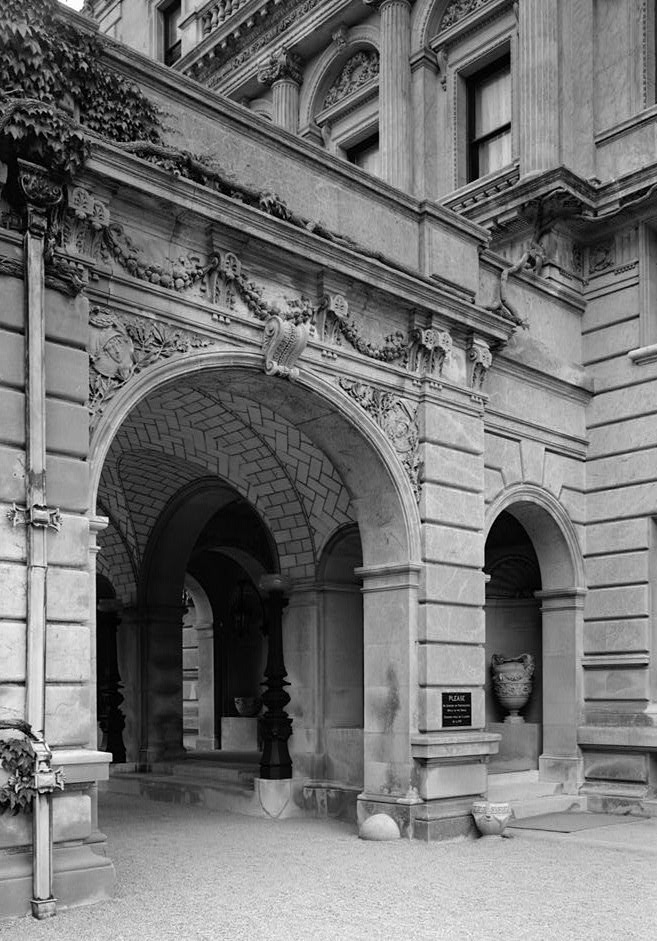
The port-cohere featured round and rectangular plaques made of rare marbles and framed in oak and laurel leaves. Acorns and oak leaves adorned the cornices and the columns held limestone masks of Apollo & Mercury
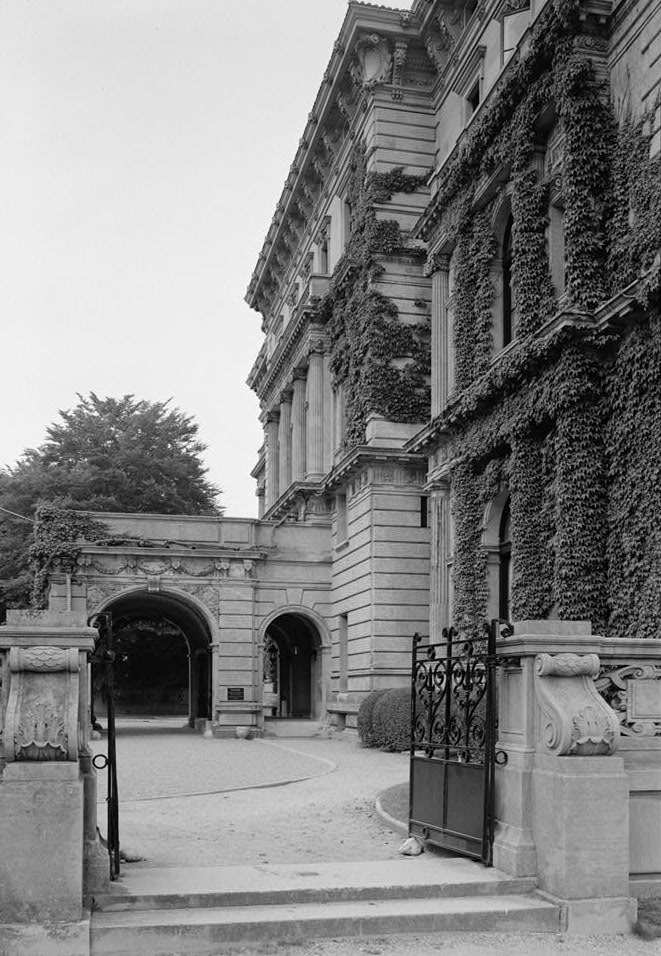
Photo by Jack Boucher, 1971 loc.gov




 OneL's Travels